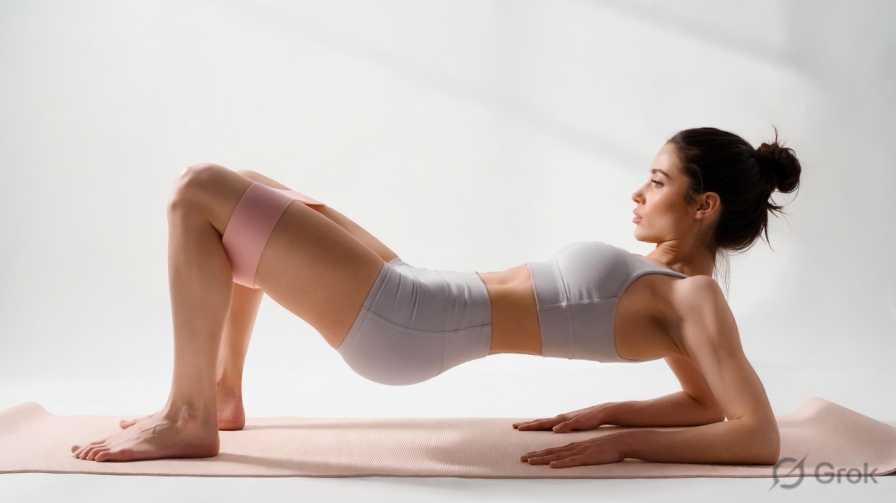
You’ve been doing crunches for years. Hundreds of them. Thousands, probably. You can feel your six-pack under there somewhere. So why does your lower belly still pooch out?
Here’s what no one at the gym told you: Your “abs” and your “deep core” are not the same thing. Not even close.
And confusing the two might be the very reason you’re not seeing the flat stomach you’re working for.
Let’s break down the anatomy, the function, and exactly how to train each one.
The Short Answer
Your “abs” (rectus abdominis) are the superficial show muscles — the six-pack you see in photos. They flex your spine forward.
Your “deep core” (transverse abdominis, pelvic floor, multifidus, diaphragm) are the hidden stabilizers — your internal corset. They wrap around your torso and pull your belly inward.
Crunches build abs. Waist vacuums build deep core. You need both. But most people train only the first and completely ignore the second.
Anatomy Lesson: What You Can See vs. What You Can’t
The Outer Unit (Your “Abs”)
Rectus Abdominis:
Runs vertically from your ribcage to your pubic bone
Divided by those horizontal tendinous lines (the “six-pack” look)
Primary job: Spinal flexion (curling forward like a crunch)
Secondary job: Stabilization during heavy lifts
External & Internal Obliques:
Run diagonally along your sides
Primary job: Rotation and lateral flexion (twisting and side bending)
What people mean when they say “love handles” (when weak) or “waist definition” (when strong)
The Deep Core (The Hidden Layer)
Transverse Abdominis (TVA):
The deepest abdominal muscle, wrapping horizontally around your torso like a back brace or corset
Fibers run side-to-side, not up-and-down
Primary job: Compress the abdominal contents and stabilize your spine
When it contracts, your waist circumference shrinks
Pelvic Floor:
A hammock of muscles at the base of your pelvis
Primary job: Support your organs and work with the TVA
Multifidus:
Tiny muscles running along your spine, segment to segment
Primary job: Stabilize each vertebra individually
Diaphragm:
Your primary breathing muscle
Primary job: Work with the TVA to create intra-abdominal pressure
The Key Difference: Function
| Abs (Rectus Abdominis) | Deep Core (TVA + Pelvic Floor) | |
|---|---|---|
| Location | Superficial (top layer) | Deep (innermost layer) |
| Muscle fiber direction | Vertical | Horizontal |
| Primary action | Spine flexion (curling) | Spine stabilization (bracing) |
| What it does visually | Creates “six-pack” bumps | Flattens the belly |
| When you feel it | Burning during crunches | Deep gripping sensation |
| What weak looks like | Can’t do a single crunch | Lower belly pooch, back pain |
Here’s the part that surprises most people: Your TVA is often asleep.
Modern life — sitting at desks, slouching on couches, wearing supportive clothing, and never bracing your core — teaches your deep core to switch off. So even when your abs are strong, your stomach pushes outward because nothing is holding it inward.
The Visual Difference
Strong abs + weak deep core = A belly that looks “blocky” or distended. You can see muscle definition, but it pushes outward rather than lying flat. Think of a bodybuilder’s relaxed stomach.
Strong deep core + weak abs = A naturally flat stomach with no visible muscle definition. Think of a slender dancer or Pilates instructor.
Strong abs + strong deep core = A flat, defined, “cinched” waist. The holy grail.
Why Most Waist Workouts Get This Wrong
Here’s what the typical “waist-slimming” YouTube video looks like:
50 crunches
30 Russian twists (with momentum, hips swinging)
20 leg raises (with lower back arching off the floor)
Maybe a plank if you’re “advanced”
What’s missing? Anything that actually targets the transverse abdominis.
Crunches don’t activate your TVA. Neither do Russian twists (if your hips are moving). Leg raises often recruit hip flexors instead of deep core. You can do hundreds of these and still have a pooch — because you’ve never taught your TVA to turn on.
How to Know If Your Deep Core Is Weak
Take this simple test:
Lie on your back with your knees bent, feet flat on the floor. Press your lower back into the mat. Now, without letting your back lift, slowly slide your right heel away from you until your leg is straight.
What happened?
If your back stayed flat and you felt a deep, low gripping sensation → Your deep core is working.
If your back arched off the mat or you felt nothing → Your deep core is asleep.
Most people fail this test on the first try. That’s not a judgment. That’s just modern life.
How to Train Each One
For Abs (The Show Muscles)
Do these 2–3 times per week:
Cable crunches or weighted crunches (higher weight, lower reps for definition)
Hanging knee raises
Captain’s chair leg lifts
Ab wheel rollouts
Goal: Muscle hypertrophy (making the muscle visible)
For Deep Core (The Flattening Muscles)
Do these 5–6 times per week (they’re low fatigue):
Waist vacuums (the single best TVA exercise) — 5 holds of 20 seconds
Dead bugs — 10 slow reps per side
Bird-dogs — 10 per side with 3-second holds
Heel slides — 10 per leg, keeping lower back glued to the floor
Diaphragmatic breathing — 10 breaths, belly rising, chest still
Goal: Motor control and endurance (teaching the muscle to stay engaged)
The Perfect Weekly Routine
| Day | Focus | Exercises | Time |
|---|---|---|---|
| Monday | Deep core | Waist vacuums, dead bugs, breathing | 8 min |
| Tuesday | Abs + deep core | Cable crunches + heel slides | 15 min |
| Wednesday | Deep core only | Bird-dogs, pelvic tilts, vacuums | 6 min |
| Thursday | Rest or walking | Japanese 3-7 breathing walk | 15 min |
| Friday | Abs + deep core | Hanging knee raises + dead bugs | 15 min |
| Saturday | Deep core only | Full deep core routine | 10 min |
| Sunday | Active rest | Walking or stretching | 20 min |
The Breathing Connection No One Talks About
Your diaphragm and transverse abdominis are connected by fascia. They’re literally designed to work together.
When you inhale, your diaphragm descends and your belly should expand (not your chest). When you exhale, your diaphragm rises and your TVA naturally contracts, pulling your belly inward.
Most people breathe backward — chest breathing with a tight, sucked-in belly. This teaches your TVA to stay relaxed and your diaphragm to stay high. The result? A chronically weak deep core and a belly that wants to push out.
Fix your breath, and you fix half your deep core problems.
Realistic Results Timeline
If you’ve never trained deep core before:
Week 1: You notice you can engage your TVA on command. Waist vacuums feel impossible at first (hold for 5 seconds only).
Week 2: You feel a deep “gripping” sensation during exercises. Your lower back pain (if you had it) starts to ease.
Week 4: Your stomach feels tighter even when relaxed. Your posture improves without thinking about it.
Week 8: Visible flattening of lower belly. Your waist measurement may drop 0.5–1 inch.
Week 12: You have a natural “cinch” to your waist that wasn’t there before. Crunches actually feel different now because your deep core stays engaged.
Note: If you have significant body fat covering your midsection, deep core exercises won’t make that fat disappear. You’ll need a calorie deficit and walking for that. But the shape underneath will be dramatically different.
Common Myths, Busted
Myth #1: “Crunches give you a blocky waist.”
Reality: Overdeveloped rectus abdominis without oblique work can create a blocky look. But the real culprit is weak transverse abdominis, which allows your belly to push outward.
Myth #2: “You can spot-reduce belly fat with deep core exercises.”
Reality: No exercise can burn fat from a specific area. Deep core exercises build muscle. Walking and nutrition burn fat. You need both.
Myth #3: “Planks are the best deep core exercise.”
Reality: Planks are great for endurance, but they don’t specifically target the TVA’s primary action (compression). Waist vacuums and dead bugs are better for waking up the deep core.
Myth #4: “You should always suck your stomach in.”
Reality: Chronic stomach sucking disconnects your diaphragm from your TVA and can actually weaken your deep core over time. You want engagement, not sucking.
The Bottom Line
Your abs and your deep core are teammates, not rivals. The six-pack makes you look good in a swimsuit. The deep core keeps your belly flat, your back pain-free, and your waist cinched.
Most people train abs obsessively and deep core not at all. That’s backwards.
Start today. Lie on the floor. Exhale completely. Pull your belly button toward your spine. Hold for 10 seconds. Feel that deep grip?
That’s your deep core waking up for the first time in years.
Now train it like it matters — because for a truly flat stomach, it’s the only muscle that does.
Did this clarify the difference for you? Drop a comment below — I’d love to hear if you’ve been focusing on abs or deep core (or neither)! 👇
Follow me for more no-fluff fitness breakdowns. No bro science. Just what actually works.