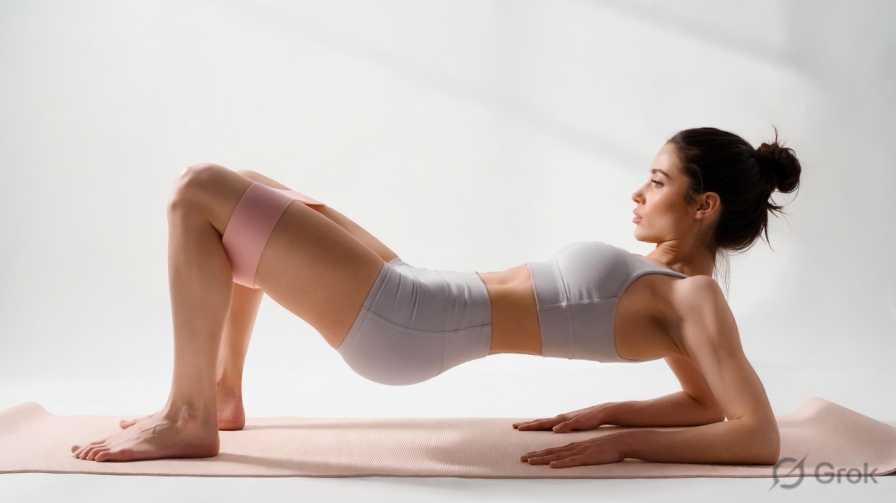
When you think of Pilates, you probably think of long, lean bodies with naturally cinched waists. There’s a reason for that.
Pilates doesn’t train your abs the way traditional workouts do. It doesn’t crunch or crank. Instead, it targets your deep core—the transverse abdominis, pelvic floor, and spinal stabilizers—using controlled, breath-driven movements that create length rather than bulk.
The result? A waistline that looks stronger, tighter, and more defined. Not blocky. Not thick. Just… cinched.
Here’s a 12-minute Pilates deep core workout designed specifically for your waist.
Why Pilates Works Differently for Your Waist
Most waist workouts rely on spinal flexion (curling forward) or rotation with momentum. These movements target superficial muscles and can actually create a “boxy” appearance if overdone.
Pilates takes a different approach:
It emphasizes elongation over compression. You’re always reaching, stretching, and lengthening.
It uses eccentric contraction (lengthening under tension), which creates long, lean muscle.
It coordinates breath with movement, engaging the deep corset muscle (transverse abdominis) on every exhale.
It works the waist 360 degrees—front, sides, and back—not just the visible six-pack area.
The result isn’t a bulky midsection. It’s a waistline that looks naturally smaller because the muscles holding it in are finally awake.
Before You Start: The Pilates Principles
These 4 rules make every exercise more effective:
1. Imprint your spine. Lie with a small curve in your lower back (not pressed flat, not arched). You should be able to slide your fingers under your lower back.
2. Zip your deep core. Pull your navel toward your spine—about 30% engagement, not a full vacuum. You should still be able to breathe.
3. Exhale on effort. Every time you curl, lift, or twist, exhale completely. Inhale to return.
4. Move slowly. Pilates is about control, not reps. A 3-second movement is harder and more effective than a 1-second movement.
The 12-Minute Pilates Deep Core Workout
Format: 45 seconds of work, 15 seconds to transition. Do each move once. Rest 1 minute after move 6, then repeat the full circuit.
Move 1: The Hundred (Pilates Signature)
Why it’s first: Wakes up your entire deep core and establishes your breath pattern.
Lie on your back, knees bent at 90 degrees (shins parallel to floor). Lift your head and shoulders off the mat. Reach your arms long by your sides, hovering above the floor.
Inhale for 5 small arm pumps
Exhale for 5 small arm pumps
Keep your ribcage still—only your arms move
Your deep core should feel engaged the entire time
Do: 50 pumps (10 breath cycles)
Modification: Keep your head on the mat if you have neck issues.
Move 2: Single Leg Stretch (Lower Belly Focus)
Why it works: Targets the deep lower abs while teaching coordination.
Start in the same position: head and shoulders lifted, knees at 90 degrees.
Exhale: Pull your right knee toward your chest as you extend your left leg straight (hovering above the mat)
Inhale: Switch legs (right leg extends, left knee pulls in)
Keep your lower back imprinted—don’t let it lift
Do: 10–12 alternating reps per leg
Feel it: Deep in your lower belly, not your hip flexors.
Move 3: Double Leg Stretch (Core Endurance)
Why it works: Challenges your deep core to stabilize while your limbs move away from center.
Curl head and shoulders up. Hug both knees to your chest.
Inhale: Extend both arms overhead and both legs straight out (hovering above floor)
Exhale: Circle your arms wide and hug your knees back in
Keep your ribcage heavy and your lower back imprinted
Do: 8–10 slow, controlled reps
Pro tip: If your back arches, don’t extend as far. Depth matters less than control.
Move 4: Criss-Cross (The Oblique Sculptor)
Why it works: Targets your waist’s rotational muscles (internal and external obliques) without swinging momentum.
Hands behind your head, knees at 90 degrees. Lift head and shoulders.
Exhale: Twist your right elbow toward your left knee as you straighten your right leg
Inhale: Return to center (knees back to 90 degrees)
Exhale: Twist your left elbow toward your right knee as you straighten your left leg
Keep hips still—only your ribcage twists
Do: 10–12 alternating reps per side
Common mistake: Using your neck to pull. Your deep core should drive the twist, not your hands.
Move 5: Side-Lying Leg Lift Series (Waist Cinch)
Why it works: Targets your obliques and quadratus lumborum (deep side core) from a different angle.
Lie on your right side, propped on your right forearm. Elbow under shoulder. Legs stacked, hips stacked.
Lift both legs together a few inches off the floor
Hold for 3 seconds, squeezing your waist
Lower with control (2 seconds down)
After 6 lifts, add small pulses at the top (8 tiny lifts)
Do: 6 holds + 8 pulses, then switch sides
Feel it: Your side waist (obliques) and the muscle just above your hip bone.
Move 6: The Saw (Pilates Waist Rotation)
Why it works: Uniquely targets the rotational deep core while creating spinal length.
Sit tall with legs straight, wider than hip-width. Arms extended out to sides at shoulder height, palms down.
Inhale to lengthen your spine (imagine a string pulling you up)
Exhale: Twist your torso to the right and reach your left hand toward your right pinky toe
“Saw” your pinky along your foot (small back-and-forth motion)
Inhale to return to center
Exhale to twist left
Do: 6–8 twists per side
Pro tip: Keep your hips heavy on the floor. The twist comes from your ribcage, not your pelvis.
Rest 1 minute. Then repeat Moves 1–6.
The Complete Circuit (Print This)
| Move | Name | Reps/Time |
|---|---|---|
| 1 | The Hundred | 50 pumps |
| 2 | Single Leg Stretch | 10–12 per leg |
| 3 | Double Leg Stretch | 8–10 reps |
| 4 | Criss-Cross | 10–12 per side |
| 5 | Side-Lying Leg Lifts | 6 holds + 8 pulses per side |
| 6 | The Saw | 6–8 per side |
| REST | 1 minute | |
| Repeat all 6 moves |
Total time: 12–14 minutes
How to Progress This Workout
Weeks 1–2: Do one circuit, 3–4 times per week. Focus on form and breath.
Weeks 3–4: Do one circuit, 5–6 times per week. Add ankle weights (1–2 lbs) for Side-Lying Leg Lifts.
Weeks 5–6: Do two circuits back-to-back, 4 times per week.
Weeks 7–8: Add these advanced Pilates moves: Teaser (if you’re ready), Corkscrew, or Jackknife.
What Makes This “Pilates” Different
Traditional core workout: Crunch, crunch, crunch. Hip swing. Momentum. Neck strain.
Pilates deep core workout: Controlled movement. Exhale on effort. Imprinted spine. Lengthening through every rep.
The difference isn’t just philosophical—it’s visual. Women who train Pilates don’t develop thick, blocky midsections. They develop long, wrapped waistlines where the deep core pulls inward rather than pushing outward.
Pairing This With Nutrition for a Smaller Waist
This workout builds deep core strength. But if you have excess body fat covering your waist, you won’t see the definition.
Pair this Pilates routine with:
The Japanese 3-7 breathing walk (10–15 minutes daily) → Inhale 3 seconds, exhale 7
Protein at every meal → Eggs, chicken, fish, tofu, Greek yogurt
Reduced sodium → Bloating hides waist progress
The “80% full” rule → Stop eating before you’re stuffed
The Pilates builds the muscle. The nutrition and walking reveal it.
Realistic Results Timeline
| Timeframe | What to Expect |
|---|---|
| Week 1 | You feel your deep core engage during exercises. Lower back awareness increases. |
| Week 2 | Criss-Cross and The Saw feel smoother. Your waist “grips” during daily activities. |
| Week 4 | Visible definition in obliques (the “slim lines” on your sides). Clothes feel slightly looser. |
| Week 8 | Noticeable waist cinch. Your standing posture is visibly improved. |
| Week 12 | Strong, defined, elongated waistline. People may ask if you’ve lost weight (you haven’t—you’ve just reshaped). |
Common Pilates Mistakes (And Fixes)
Mistake #1: Holding your breath.
Fix: Exhale audibly. Hear yourself breathe out. Silent breath usually means shallow breath.
Mistake #2: Letting your lower back lift.
Fix: Imagine you have a glass of water balanced on your lower back. Don’t spill it.
Mistake #3: Rushing through The Hundred.
Fix: Count out loud. “In-2-3-4-5, out-2-3-4-5.” The rhythm is the exercise.
Mistake #4: Clenching your jaw or neck.
Fix: Keep your tongue on the roof of your mouth. Relax your shoulders away from your ears.
Why Your Waistline Will Thank You
Pilates isn’t trendy. It’s been around for nearly a century for one reason: it works.
The women with those long, lean, cinched waists aren’t doing hundreds of crunches or Russian twists with a medicine ball. They’re doing controlled, breath-driven deep core work—just like this routine.
Your waistline isn’t just about fat loss. It’s about muscle function. When your deep core is strong, your waist holds itself smaller naturally. All day. Every day. Without you even thinking about it.
That’s the Pilates promise. And it’s waiting for you on your mat.
Have you tried Pilates for your waist before? Drop your favorite move in the comments—I’m a sucker for a good Criss-Cross! 🧘♀️✨