7 Plank Variations That Work More Than Just Your Abs
The classic plank is a core-strength staple for a reason. But if you’re only doing the standard version, you’re missing out.
Your core isn’t just your abs—it’s a group of interconnected muscles including your abdominals, back muscles, hips, and pelvis. Some of these muscles work as stabilizers that protect your spine, while others generate power for everyday movement like bending, lifting, and twisting . To train all of them, you need variety.
Here are 7 plank variations that challenge different muscles, improve stability, and keep your workout anything but boring.
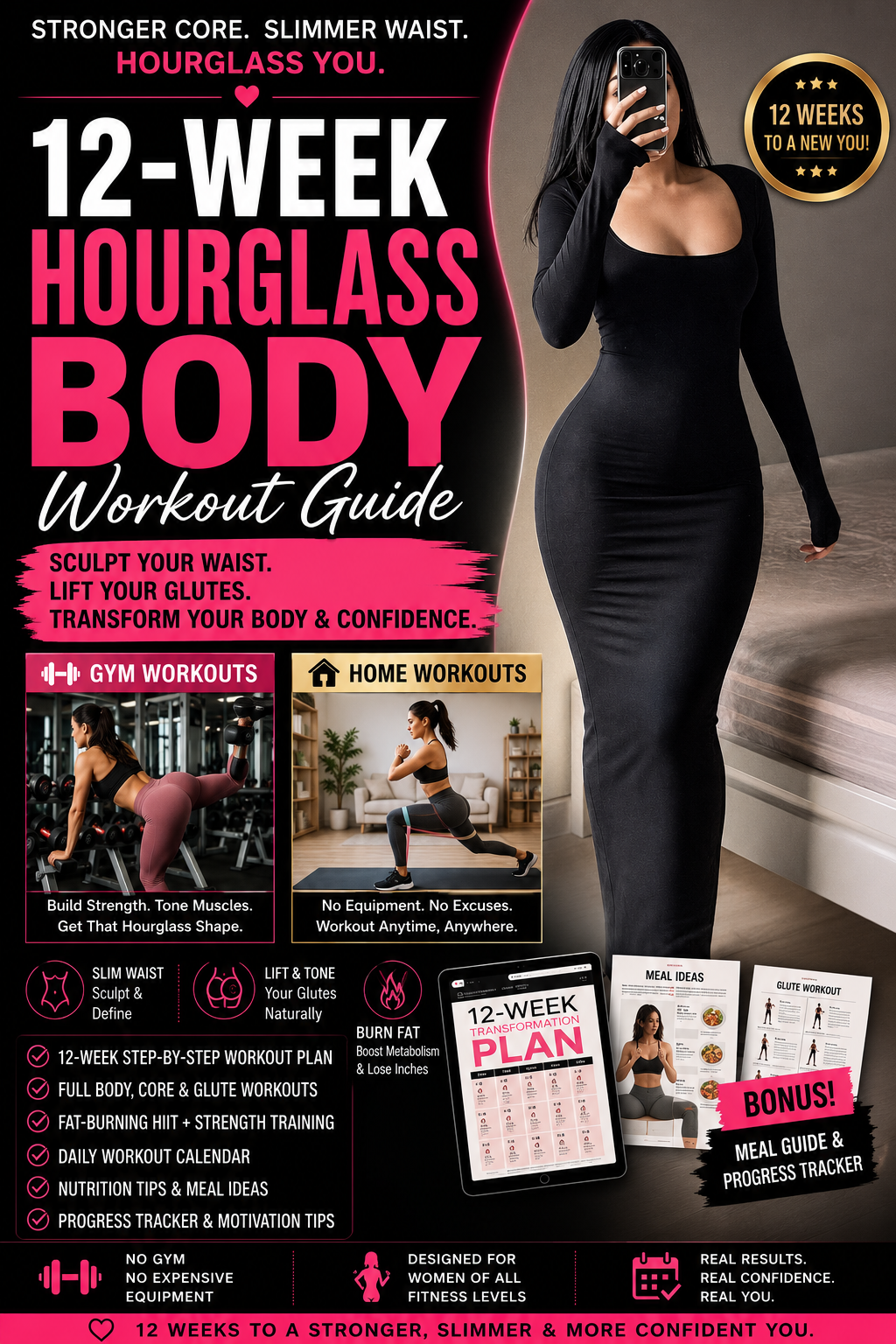
Want to build a more defined hourglass shape?
Discover the step-by-step Hourglass Body Guide designed to help you structure your workouts and stay consistent.
👉 Explore the Hourglass Body eBook
1. Side Plank
Forget six-pack isolation—this is the move that builds lateral core strength and stability. It “engages and activates the entire body, not just the ‘superficial’ ab muscles,” making it a true test of balance and strength .
Muscles worked: Obliques, deep core stabilizers (quadratus lumborum), glutes, shoulder stabilizers, rotator cuff .
How to do it:
Lie on your side with legs extended and stacked
Prop yourself up on your forearm, elbow directly under shoulder
Lift your hips until your body forms a straight line from head to heels
Keep your hips square and don’t let them drop
Hold: 30 seconds per side
Beginner modification: Keep your bottom knee on the floor for extra support .
Expert tip: To avoid arching your lower back, press your hips forward and keep your upper body from rotating. “Your body should be in a straight line from ankles to shoulders” .
2. Copenhagen Plank
This one shifts the focus from the front of your body to the sides, similar to a side plank, but with an extra challenge—it’s a unilateral exercise. That means it can help “identify and reduce side-to-side imbalances” .
What makes it different: Unlike a standard side plank where both legs are stacked on the floor, the Copenhagen plank places your top leg on a bench (or sturdy surface), making it significantly harder on the stabilizers.
What it targets: Obliques, glutes, inner thighs, shoulder stabilizers .
Hold: 20-30 seconds per side
3. Reverse Plank
This is one of the only plank variations that focuses heavily on lower-body strength . It’s a game-changer if you sit all day.
Muscles worked: Glutes, hamstrings, lower back, core, shoulder stabilizers .
How to do it:
Sit on the floor, legs extended in front of you
Place your hands behind you, fingers pointing toward your feet
Press through your hands and heels to lift your hips
Your body should form a straight line from shoulders to ankles
Hold: 10-30 seconds
Beginner modification: Bend your knees instead of keeping legs straight .
4. Bear Plank (Bear Hover)
This is what happens when you level up the classic plank. Instead of resting on your feet, you hover on your knees—and it’s deceptively hard.
Muscles worked: Deep core (transverse abdominis, obliques), shoulders, hips .
How to do it:
Start on all fours, hands under shoulders, knees under hips
Lift your knees just 1-2 inches off the floor
Hold, keeping your back flat and core braced
Hold: 15-30 seconds
Why it works: “Because you’re hovering rather than resting on your knees, your deep core has to fire the entire time just to keep you level” .
Make it harder: Add shoulder taps by lifting one hand to tap the opposite shoulder while holding the hover . Or try a bear plank leg lift by extending one leg back .
5. Plank Hip Dips
This variation adds movement to the static plank, forcing your obliques and core stabilizers to work in a dynamic way.
Muscles worked: Obliques, transverse abdominis, shoulders.
How to do it:
Start in a forearm plank position
Drop your right hip toward the floor, then return to center
Immediately drop your left hip toward the floor
Alternate sides with control
Reps: 10 per side
Form cue: Keep your hips from swaying excessively—control the movement.
6. Up-Down Plank (Plank Transitions)
This one cranks up the upper body engagement . It also builds shoulder stability and endurance.
Muscles worked: Core, triceps, shoulders, chest.
How to do it:
Start in a high plank (hands on the floor)
Lower to your right forearm, then your left forearm
Press back up to your hands—right hand first, then left hand
Repeat, alternating which arm leads
Reps: 10-15 per side
Beginner modification: Bring your knees to the ground during the transitions .
7. Single-Leg Plank
Removing one base of support creates an anti-rotation challenge that forces your deep core to work harder just to keep you stable .
Muscles worked: Core, glutes, hip stabilizers.
How to do it:
Start in a standard plank position
Lift one foot 1-2 inches off the ground
Keep your hips square—don’t let them twist
Lower, then switch legs
Hold: 10-15 seconds per leg
Expert tip: “Your body should be in a straight line, not an arch. Keep your head, spine and legs neutral” .
How to Add These to Your Routine
Trainers recommend incorporating plank variations at least 3 times per week. “I recommend finishing each workout with core activation, so doing a plank challenge before heading out would be ideal” .
Sample circuit: Pick 3-4 variations from this list and do 3 rounds for the recommended time with 30 seconds rest between each move . As your strength improves, challenge yourself with more advanced variations.
Struggling to build your waist, glutes, and overall shape with random workouts?
The Hourglass Body eBook gives you a structured approach you can follow from home.
→ See What’s Inside the Hourglass Body Guide